
One Stitch at a Time
Happy 104th Birthday, Dad.

“Asking God doesn’t always produce answers, but slowly, imperceptively, a relationship begins to develop between the questioner and the One questioned.…Make a habit of it. Be a struggling seeker. The power to continue is found in the questions, not in the answers.”[1]
An Aramco magazine I found by accident a few months ago had an article on Al Sadu, the ancient art in the Middle East of gathering fibers from animals belonging to a tribe ─ camels, goats, and sheep ─ washing the fibers, then combing and teasing them, before spinning them to create a continuous yarn. As I read about the communal nature of this disappearing art, I saw myself in a workshop in Missoula, Montana, somewhere between 1979 and 1983, learning how to comb sheep’s wool to prepare it for spinning into a skein of yarn I could use to knit an object. It was frustratingly hard work but fun as I struggled like other members of the workshop to learn how indigenous peoples and early homesteaders created the materials they needed to survive.
Al Sadu is a specific technique of weaving in geometrical shapes hand-woven by Bedouin people. “Sadu House in Kuwait was established by the Al Sadu Society in 1980 to preserve the interests of the Bedouins and Sadu weaving.…Woven geometric and figurative patterns and symbols such as triangles and diamonds represent tribal identity as well as the elements of the desert and the weavers’ creative self-expression. These designs are seen as a way of storytelling, cultural meaning, and social identity.…With the demise of tribal existence and the decline of associated weaving skills and memories, the demands for tribal camel textiles virtually ceased, and so Al Sadu weaving and nomadic animal husbandry, once crucial and vital, were in decline.”[2] But, as in Montana, traditional weaving skills had a growing audience. By 2025, the United Arab Emirates, Saudi Arabia, Kuwait, and Qatar were included on the Representative List of the Intangible Cultural Heritage of Humanity” and as the Aramco article detailed, Al Sadu was back and growing.[3]
As I write this post, I am reminded of my Substack mentor, Randy Tibbits, who creates amazing needlepoint, and of my father (1918-1997), during the steel strike in 1952. He had quit his job as Sales Manager for a small company in Pittsburgh because, according to family lore, the two owners had promised him presidency of the company when they decided to retire; however, one of the owners had a daughter who married a graduate of an Ivy League college. He was hired and promised the presidency. My father remained the Sales Manager.
Dad had not been able to complete a college degree after graduating from high school in 1936 because the scholarships he had been awarded disappeared at the end of his sophomore year. My grandfather couldn’t pay tuition, but he did help Dad win a position at Mesta Machine, a specialty steel company in Pittsburgh, where he apprenticed to become a metallurgist. He apparently had had some mental issues with disappointment before joining Mesta and they reappeared after he lost his temper and quit his job in 1952.
In 1952, Pittsburgh was the “Steel Capital of the World.” No sooner did Dad quit than 560,000 mill workers in the United States, members of the United Steelworkers of America (USWA), called a strike against U.S. Steel (USS) and nine other steelmakers. The issue: the steel workers wanted a wage increase and the steel companies refused.[4] On April 9, hours before the workers were scheduled to walk out, President Harry Truman nationalized the American steel industry. “The steel companies sued to regain control of their facilities. On June 2, 1952, in a landmark decision, the Supreme Court ruled in Youngstown Sheet & Tube Co. v. Sawyer, 343 U.S. 579 (1952), that the President lacked the authority to seize the steel mills. The strike lasted 53 days and ended on July 24, 1952, on essentially the same terms that the union had proposed four months earlier.”[5]
Fifty-three days is a long time for a man, the sole breadwinner of a family of four, to be out of work. The last thing the steel companies wanted to do was interview him or anyone else. And he couldn’t collect unemployment benefits. He wasn’t laid off; he had quit, lending credence to the “widespread belief that unemployment was a matter of individual failing.”[6]
Our family doctor had attended high school with my parents. He prescribed taking up a hobby that would help Dad reflect and relax: cross-stitching. As he sat in a lawn chair in our driveway on Princeton Place, stitching, he would talk with us as we worked on our smaller cross-stitching projects and gossip with neighbors passing by. Being a male doing cross-stitching never seemed to bother him.
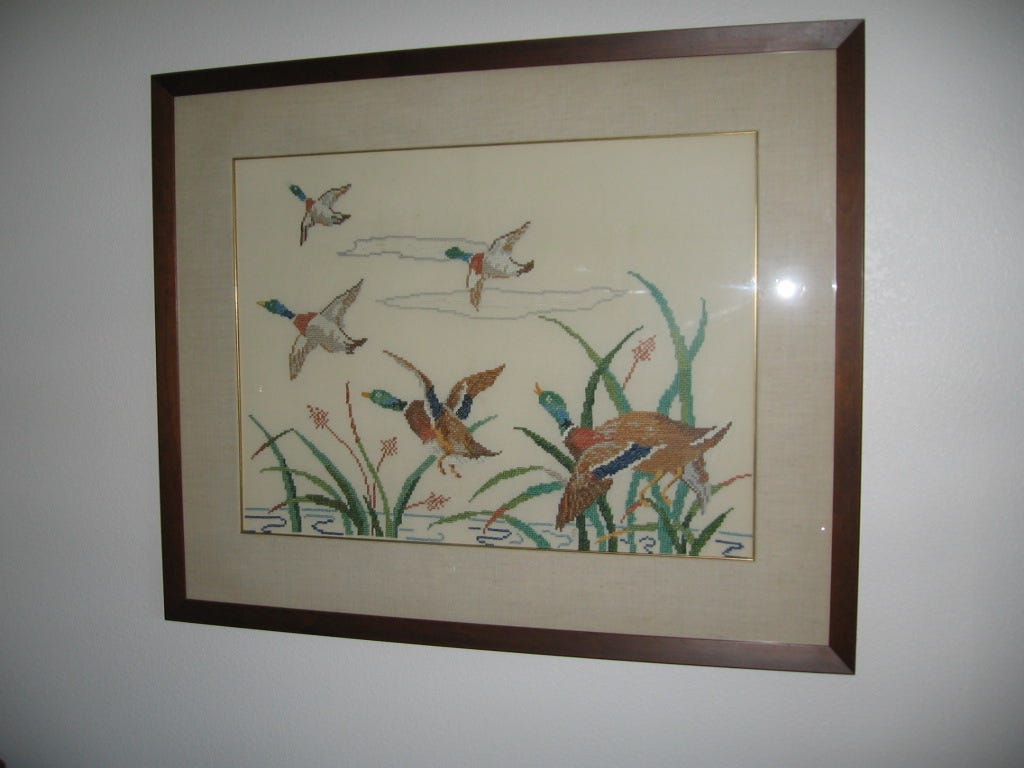
After I read the book, The Help, I was persuaded by a friend to go see the movie. As the young mothers played bridge in a sunken living room with wood-paneled walls, I noticed a cross-stitch of Mallard ducks over a pond on one wall. It was exactly the same as the piece my father had done and which I inherited after his death in 1997.
As I downsized here in Houston in 2016, I donated my father’s creation, which had been stretched and framed in museum glass, to a friend who loved going down to the Gulf to fish. He inherited his parents’ home, complete with a wood-paneled den.
To go back to the passage written by Rev. Larry Hall: “Be a struggling seeker. The power to continue is found in the questions, not in the answers.”
My father struggled to find a job for at least six months before he was hired by a large international steel supply company headquartered in London to oversee the manufacture and distribution of their products in the United States. He stopped cross-stitching after he flew to England, Scotland, Ireland, France, and Germany to train, then came home and traveled the country turning the new branch into one of the most successful steel suppliers in the United States. He was quickly promoted to Vice President of Sales and traveled the world. When he retired to Medina, Ohio, I went to visit the house he had designed with the architect. It had a “game room” with a recliner and a television set. The walls were wood-paneled, decorated with the Mallard duck cross-stitch.
Dad was born in 1918, 104 years ago today. Happy Birthday, Daddy!
[1] Rev. Larry Hall, St. John the Divine Episcopal Church, River Oaks Boulevard at Westheimer Road. Sermon/Bulletin, May 5, 1991. “Questions and Answers.” Author’s personal collection.
[2] “Al Sadu,” Wikipedia, accessed June 29, 2026.
[3] Keireine Canavan and Ali Alnajadar. “The association between Bedouin Al - Sadu weaving and the camel” (PDF). School of Oriental and African Studies. Archived from the original (PDF) on 19 November 2014. Retrieved 18 May 2016, in “Al Sadu,” Wikipedia, accessed June 29, 2026.
[4] “Analysis of Work Stoppages During 1952” (PDF). Bureau of Labor Statistics: 19; in “1952 Steel Strike,” Wikipedia, accessed June 29, 2026.
[5] Maeva Marcus, Truman and the Steel Seizure Case: The Limits of Presidential Power, New York: Columbia University Press, 1977, 253; in “1952 Steel Strike,” Wikipedia, accessed June 29, 2026.
[6] GovFacts, https://govfacts.org/rights-freedoms/economic-workplace-rights/unemployment-benefits/a-history-of-unemployment-benefits-in-the-united-states, accessed June 29, 2026.